
IQ, OQ, PQ: Why Proper Equipment Qualification Matters in Compounding Pharmacies
Introduction
In the world of sterile and non-sterile compounding, the reliability of equipment is directly tied to patient safety. Whether it’s a dry-heat oven, a laminar airflow hood, a depyrogenation chamber, an autoclave, or a mixing system, every piece of equipment used to produce compounded preparations must perform consistently and within defined specifications.
That’s where IQ/OQ/PQ—Installation Qualification, Operational Qualification, and Performance Qualification—comes in.
Despite being foundational elements of a compliant quality program, IQ/OQ/PQ is one of the most misunderstood and inconsistently executed requirements across 503A and 503B facilities. Many pharmacies think of qualification as a one-time event, a vendor responsibility, or a simple checklist. In reality, it’s a structured, science-driven process designed to ensure equipment continues to perform as intended over its life cycle.
This article breaks down what IQ, OQ, and PQ really mean, why they matter, and how proper qualification protects your patients, your business, and your regulatory standing.
What Is IQ/OQ/PQ? A Simple Breakdown
Installation Qualification (IQ): “Did we install it correctly?”
IQ confirms that equipment is:
Installed according to manufacturer specifications
Connected to appropriate utilities
Supported by required documentation
Controlled and traceable through asset management
IQ typically includes:
Verification of model, serial number, and configuration
Utility checks (electrical, HVAC, compressed air, etc.)
Calibration certificates
Manuals, schematics, and SOP references
Environmental requirements (clearances, ventilation, temp/humidity ranges)
Why it matters:
If the installation isn’t correct, nothing that follows can be trusted. IQ establishes a compliant baseline.
Operational Qualification (OQ): “Does it operate within defined limits?”
OQ tests the equipment’s functions without product load to ensure it behaves consistently under various operating conditions.
Common OQ elements include:
Control panel checks
Alarm and interlock verification
Timer and sensor accuracy
Temperature or pressure cycling
Airflow and filter integrity (for hoods)
OQ ensures the equipment responds properly to:
Upper and lower operating ranges
User inputs
Safety limits
Environmental influences
Why it matters:
OQ validates the equipment’s ability to operate correctly and safely—before it’s ever used for compounding.
Performance Qualification (PQ): “Can it perform as intended during real-world use?”
PQ proves that the equipment works in the way your facility will use it, with actual loads and operational conditions.
PQ includes:
Thermal mapping studies
Depyrogenation or sterilization load patterns
Media-fill considerations (when applicable)
Representative batch testing
Reproducibility checks
PQ must demonstrate consistent, repeatable performance.
Why it matters:
PQ is where regulators look most closely, because it bridges equipment capability with actual patient-impacting processes.
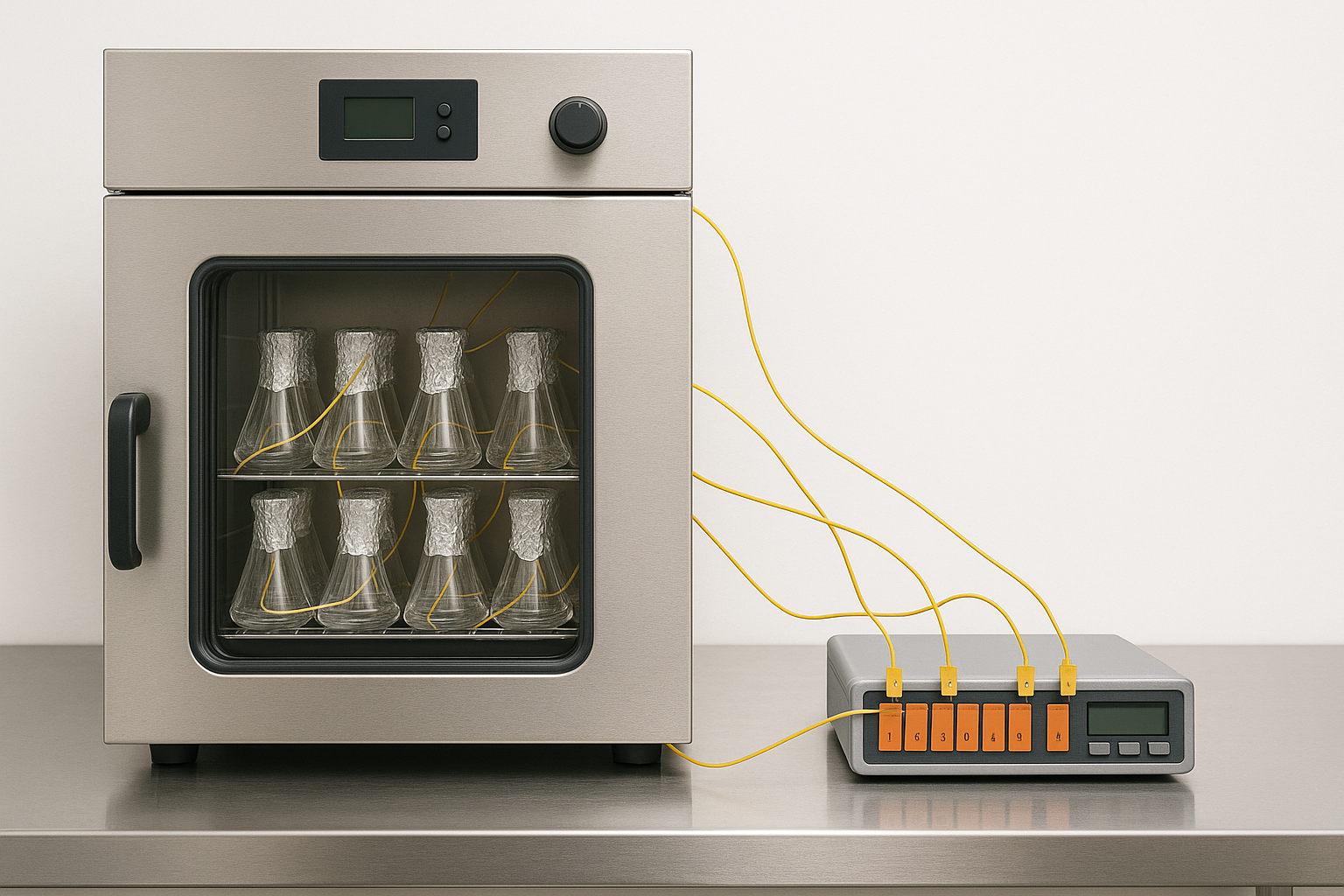
Performance Qualification
Thermal Mapping and Heat Penetration Study
Why IQ/OQ/PQ Matters for Compounding Pharmacies
Whether you are a 503A or 503B facility, proper equipment qualification is essential for:
1. USP <795>, <797>, <800> and FDA expectations
Regulators expect equipment to be qualified before use and throughout its lifecycle.
They also expect defensible documentation—not vendor brochures or incomplete checklists.
2. Patient safety
Incorrect temperatures, airflow inconsistencies, inaccurate mixing speeds, or faulty sterilization parameters can directly impact product quality.
3. Process validation
You cannot validate a process (like depyrogenation or sterilization) unless the equipment used in that process is qualified.
4. Preventing regulatory observations and 483s
Incomplete or poorly structured IQ/OQ/PQ documentation is a top observation in both 503A and 503B inspections.
5. Defensible engineering controls
Qualification creates a data trail that demonstrates your engineering systems work the way they should.
Common Problems Found During Pharmacy Inspections
Most pharmacies believe their equipment is “qualified,” but inspection findings often reveal gaps like:
Missing or incomplete IQ documentation
OQ testing not performed at min/max limits
PQ never completed or done incorrectly
Inadequate thermal mapping practices
No defined acceptance criteria
Vendor-performed IQ/OQ without facility-specific PQ
Outdated or unrepeatable test methods
No requalification schedule defined
These issues all create significant vulnerabilities during regulatory review.
How Often Should IQ/OQ/PQ Be Performed?
A common misconception is that qualification is a one-time event.
In reality, you must requalify equipment when:
Significant repairs occur
Equipment is moved
Software or control systems are updated
Preventive maintenance may affect performance
Environmental conditions change
A defined qualification interval is reached (often annually or biennially)
A strong qualification program includes:
A written lifecycle approach
Defined requalification triggers
Preventive maintenance integration
Change control alignment
How Pharmacy Solutions Consulting Helps
Our engineering-driven IQ/OQ/PQ services ensure your equipment:
✔ Is installed according to compliance standards
✔ Operates properly across intended ranges
✔ Performs consistently in real-use scenarios
✔ Has clear, defensible documentation
✔ Meets USP, FDA, and State Board expectations
Whether you are qualifying a single piece of equipment or developing a full qualification program, we provide practical, compliant, and science-based direction.
Conclusion
IQ/OQ/PQ isn’t busywork—it’s the foundation of safe, reliable compounding.
When performed correctly, qualification gives pharmacies confidence in their equipment, strengthens regulatory compliance, and supports patient safety in every batch produced.
If your facility needs support developing or executing qualification programs, we’re here to help.
Ready to strengthen your equipment qualification program?
Schedule a consultation and let’s ensure your systems are compliant, defensible, and engineered for long-term performance.
